
Months 8, 9, and 10 don’t feel like three separate chapters.
They feel like one long, continuous movement — forward, faster than you expect.
This is the period when time starts slipping through your fingers. Not because nothing happens, but because too much happens at once.
Your baby is no longer “becoming” something. They are something new every few days.
One day they sit. Then they crawl. Then they pull themselves up.
Then they look at you with intention — not just need, but decision.
And you, somewhere in between diaper changes, meals, naps, and night wakings, start to realize that details are already fading.
Month 8: Curiosity With Momentum
Around month 8, movement becomes purposeful. Not just rolling or wobbling — but going somewhere.
The world is no longer observed from one spot. It’s explored.
Everything is tested: textures, sounds, reactions, boundaries. There is joy in discovery, but also frustration.
Your baby wants more than their body can sometimes deliver — and that gap shows.
Sleep can become unpredictable again. Not because something is “wrong,” but because the brain is busy building. Some nights we took turns walking the room in silence, both too tired to talk, but both there.
This month asks for patience — and trust. It was also the month of unexpected joy.
R discovered dancing — and I don’t think I’ve ever laughed harder, at him and with him.
At first, he just moved his head. Then his hips. Then his little legs, stomping and bouncing to any melody.
It was ridiculous. And perfect.
This was also when teething began. Later than “expected,” maybe — but with drama.
For us, the first lower middle teeth came with exactly what every parent warns you about and the internet and doctors often dismiss: a low-grade fever, unusual apathy, a couple of loose stools, and even projectile vomiting.
The day after the vomiting, we were at the pediatrician. Of course, there was nothing wrong. Was it the teeth? The huge amount of drool? Something else?
I still don’t know for sure. But check the symptoms.
Always check. It’s better to say “I worried for nothing” than “If only I had known.”

Month 9: Awareness Changes Everything
Month 9 often brings a subtle shift — easy to miss, impossible to ignore once it’s there.
Your baby understands more than they can express. They recognize routines. They anticipate outcomes.
They notice when you leave the room — and when you come back.
Separation anxiety may appear. Not as a problem, but as proof of attachment.
Emotion becomes louder: laughter is fuller, frustration is clearer, preferences are obvious.
In our case, it was cucumber and puffs — the combination that ruled our lives for almost two months.
He wanted nothing else. I tried everything. I cooked everything.
I don’t think I’ve ever been more frustrated. I wanted to cry at every meal — and often did.
Most days, my husband was the one reminding me to breathe, to step back, to let one bad meal be just that — one meal.
While I worried about every bite, he worried about me.
You’re no longer caring for a baby who reacts. You’re caring for a baby who responds.

Month 10: Independence, With One Eye on You
By month 10, confidence grows — but it’s not reckless.
He explores, climbs, reaches… and then looks back. Sometimes at me. Sometimes at his father — waiting for applause, approval, laughter.
Their games are louder than mine. Less organized. Full of movement and joy.
Communication becomes more intentional — gestures, sounds, expressions. Play turns into experimentation. And you, as a parent, start doing something quietly important:
You stop trying to control every step. You start creating safe space instead.
And Somewhere in Between, There Is Him
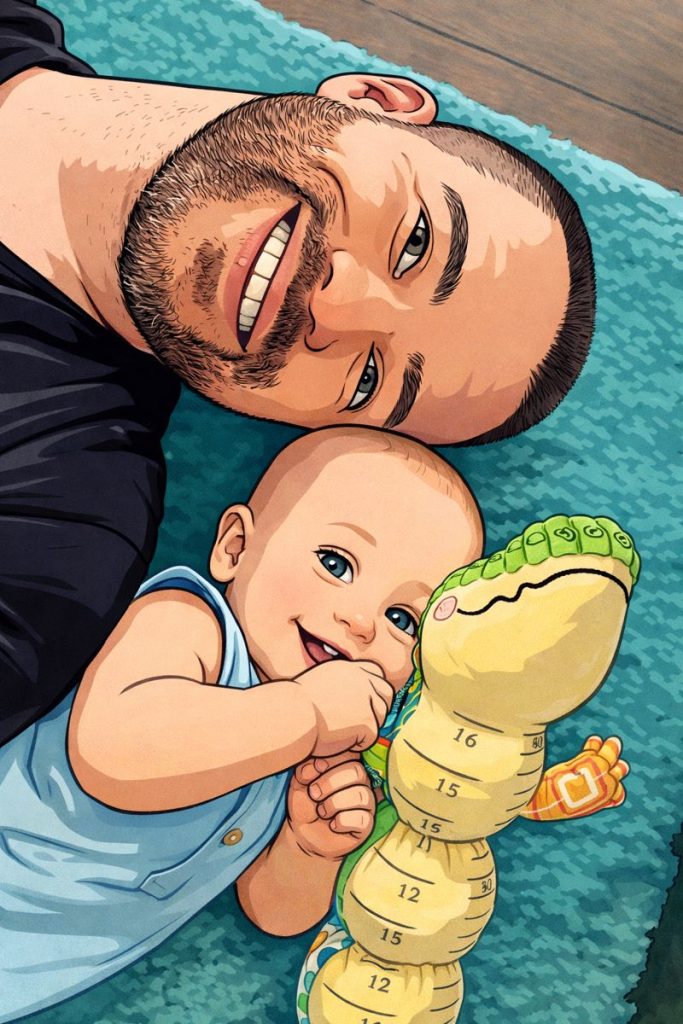
Somewhere between all of this — the milestones, the frustration, the laughter, the exhaustion — there is my husband. Quietly present. Sometimes overwhelmed.
Often tired in a different way than I am.
Always there to catch not only R when he falls, but me too.
He learned our baby alongside me. Not from instinct, but from attention.
He found his own rituals: the way he makes him laugh when nothing else works, the calm voice he uses when I’m already running on empty, the patience I didn’t know could be learned.
These months changed him too. Not loudly. But steadily.
Watching them together — especially now, when our baby looks at him with recognition and excitement — reminds me that this journey was never meant to be carried alone.
Even when it feels lonely. Even when we’re exhausted in different corners of the same room.
Parenthood doesn’t divide love. It stretches it.
And maybe that’s why one hour together now feels more precious than entire evenings once did — to cuddle, to talk, to watch Formula 1 with a plate of food or a coffee, or to escape the house just to eat somewhere else.
Moments that once felt normal are now quietly sacred.

What These Months Taught Me
Months 8–9–10 taught me that progress isn’t linear, memory is fragile, and perfection is irrelevant.
They taught me that parenting isn’t about documenting everything — but about being present enough to let it change you.
If your baby is loved, fed, held, and allowed to explore safely — you are doing more than enough.
The rest is detail. And details can be written later.